

The Trade Promotion Forecasting Challenge in Consumer Products
Trade promotions are one of the largest line items for consumer products manufacturers, with P&L often accounting for up to 20% of gross sales. Yet many promotions underperform, leaving sales teams frustrated and finance leaders questioning ROI. Traditional forecasting approaches, rooted in historical averages and manual spreadsheets, simply can’t keep up with today’s market volatility and consumer shifts.
Retail environments shift as quickly as weather patterns. Like predicting storms, forecasting promotions based only on past performance leaves consumer products manufacturers vulnerable to surprise.
Artificial intelligence (AI) is transforming trade promotion optimization (TPO). By analyzing several causal factors such as shopper behavior, price elasticity, and competitive dynamics, AI systems enable manufacturers to forecast promotion outcomes with greater precision, improving both sales volume and margin performance.
Why Does Forecast Accuracy Matter for Trade Spend Performance?
Forecast accuracy isn’t just about predicting sales—it’s about managing the entire revenue generation process. A poor forecast can cause costly ripple effects: stockouts, excess inventory, inaccurate trade accruals, and weak post-event analysis.
Deloitte’s Consumer Products Outlook 2024 found that even a 1% improvement in forecast accuracy can generate millions in working capital savings for large consumer products companies. That kind of efficiency is critical to maintaining profitability amid rising trade costs, shifting consumer demand, and tighter retail collaboration.
Accurate AI-driven forecasts act as an early warning system, helping companies anticipate both market storms and sunny periods.
What are the Limitations of Traditional Trade Promotion Forecasting Approaches?
Most consumer goods companies still rely on models built around last year’s performance to achieve an incremental percentage uplift in merchandise conditions. These legacy methods typically overlook crucial factors—seasonality, price changes, regional trends, and competitive actions—and fail to adapt when market conditions shift.
Compounding the issue, data silos exist between trade, finance, and sales systems, making it difficult to reconcile forecasts or track accuracy. Without unified, data-driven insights, finance teams spend too much time on reconciliation and too little on optimization.
How AI in Trade Promotion Optimization Improves Forecast Accuracy
AI forecasting models integrate multiple internal and external data sources—such as price, promotion, advertising, weather, and even macroeconomic indicators—to understand what drives demand in each retail environment.
AI spots patterns humans miss, like how weather affects shopping behavior in specific regions or when competitor pricing will steal share. AI-driven TPO tools also allow “what-if” scenario testing, helping account teams model the likely sales and margin impact of various promotional strategies before committing spend.
With AI, companies get a full radar view of market conditions, enabling them to adjust trade spend like a meteorologist suggesting flight reroutes around a storm.
By bringing these insights together, AI doesn’t replace human decision-making—it enhances it, providing data-backed confidence for finance and sales leaders making high-stakes trade investment decisions.
What Are the Real Business Impacts of AI in Trade Promotions for Finance and Sales Leaders?
Implementing AI in trade promotion forecasting delivers measurable results across functions:
- Finance executives gain cleaner trade accrual entries and faster reconciliations at period close.
- Trade Marketing Analysts achieve greater visibility into trade budget utilization and can identify underperforming events early.
- Sales leaders use evidence-based forecasts to ensure plans will deliver sales objectives and justify funding levels.
- Account managers access predictive insights to improve volume and margin outcomes.
Manufacturers adopting AI-driven TPO often realize trade efficiency, improved strategic trade investment for a profitable ROI, and stronger alignment between finance and commercial teams—all powered by trusted, accurate forecasts.
How Can Consumer Products Manufacturers Get Started with AI in Trade Promotion Optimization?
Adopting AI in trade promotion forecasting doesn’t require a complete system replacement. The most successful manufacturers start small—testing AI-based forecasting in a single category or with a major retail customer, with a few additional causal factors beyond the traditional —and scale as results are proven.
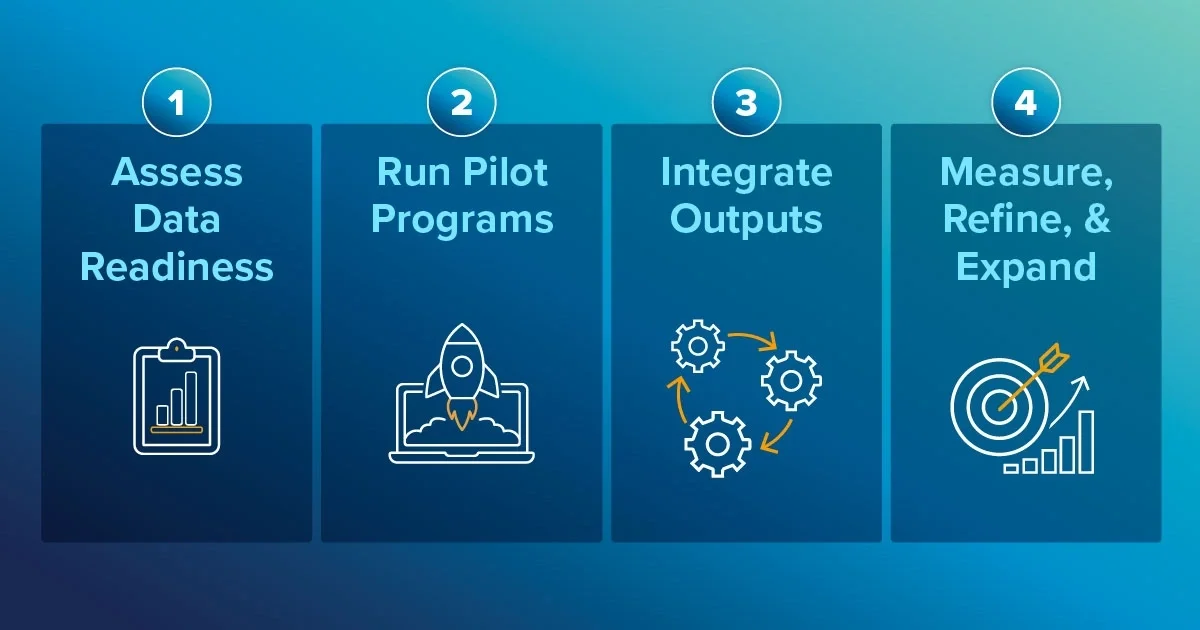
Key steps to begin using AI in trade promotion forecasting:
- Assess data readiness. Harmonize product, retailer, promotion and consumer insights data for consistency.
- Run pilot programs. Compare AI forecast accuracy to traditional predictive forecasting.
- Integrate outputs. Feed AI insights into revenue planning, trade accruals, and post-event analysis.
- Measure, refine, and expand. Apply AI to evaluate forecast accuracy and business impact continuously.
Deloitte’s research underscores that companies investing in predictive analytics are better equipped to manage volatility and optimize profitability—advantages that compound as models mature.
AI enables companies to prepare for sudden market “fronts,” adjusting trade strategies in real time, just as a weather team might issue alerts to help protect people and property.
What is the Future of AI in Trade Promotion Forecasting?
AI’s role in trade forecasting is rapidly expanding toward hyper-accurate predictions and the integration of live point-of-sale, syndicated, loyalty, and new shopper insights data, enabling adaptive forecasts that update as multiple conditions change.
In parallel, generative AI is emerging as a user interface layer, allowing finance and sales teams to query promotion data conversationally:
“What if we reduce the trade budget for Retailer A by 5% and shift it to Retailer B next quarter?”
These capabilities will extend AI beyond forecasting to support end-to-end revenue growth management, unifying pricing, promotion, and performance insights across the organization.
Turn Forecast Accuracy into a Competitive Advantage
AI in trade promotion optimization helps consumer products manufacturers turn uncertainty into opportunity. By improving forecast accuracy, manufacturers can better allocate trade funds, strengthen retailer relationships, and deliver profitable growth with confidence.
In today’s market, AI is the trusted meteorologist guiding trade spend decisions, helping teams weather both sunny and stormy skies.