

Drive More Accurate Demand Forecasts. Integrate Fragmented Financial and Commercial Data
How does Data Digitization Improve CPG Demand Forecasting for Finance Teams?
In consumer packaged goods manufacturing, demand forecast accuracy isn’t created on formulas or algorithms alone. It’s achieved when finance departments digitize and integrate trade promotions, accruals, deductions, net sales and cost data into the core of planning. Forecasts fail when business leaders feed them incomplete truth.
The damage is rarely subtle when forecasts are amiss. Revenue targets slip. Margins thin. Cash flow becomes unpredictable. Working capital inflates in all the wrong places. For CFOs, poor sales volume planning isn’t an operational inconvenience; it’s a financial liability.
Historically, the responsibility of forecasting has rested with supply chain or demand planning. That boundary is eroding, though. As trade spend becomes more complex and retailer expectations climb, forecast performance and margin protection are increasingly shaped by the quality of finance and accounting data.
Why Demand Forecast Accuracy is a Finance and Accounting Responsibility
Demand forecasts directly influence some of the most critical outcomes finance leaders are accountable for, including revenue planning and guidance, trade spend effectiveness, retailer profitability analysis, and inventory and working capital management. When forecasts are off target, the impact extends well beyond supply chain inefficiencies to include missed revenue targets, margin erosion, and cash flow volatility.
For many CPG manufacturers, forecast error does not stem from weak statistical models. Instead, it originates in fragmented financial and commercial data, particularly trade promotions, accruals, deductions, and net sales realization. This fragmented data causes demand planning systems to receive incomplete inputs, reducing forecast accuracy.
Some research from McKinsey supports this challenge: Poor data integration across commercial and financial functions is considered a leading contributor to forecast inaccuracy, and companies with integrated planning data can improve forecast accuracy by 20–30%.
How Data Flows Leads to More Accurate Demand Forecasts
Improving demand forecast accuracy starts with the processes finance and accounting teams use to capture, centralize, reconcile, and activate commercial data across trade, accrual, deduction, and net sales data.
For finance teams, this data flow follows four steps: ingesting structured (trade plans, accruals, invoices, and cost of goods sold (COGS)) and unstructured (deal terms, customer communications, and promotion execution details) data, harmonizing it across systems, enriching it with historical and retailer context, and formatting it for forecasting and analytics.
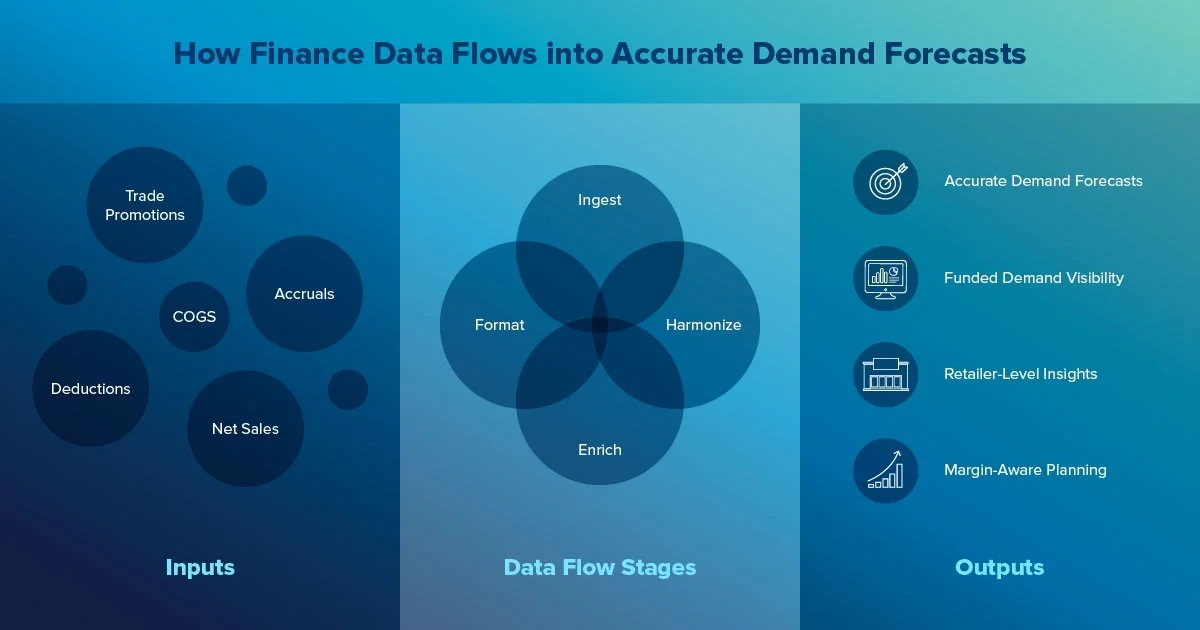
Once ingested, data must be harmonized across systems so trade, sales, and finance metrics align to the same definitions and hierarchies. Enrichment adds context such as historical promotion performance, retailer contribution and deduction behavior. Formatting follows, ensuring the data is usable by forecasting, planning, and analytics tools. When this end-to-end data flow is digitized and governed by finance, demand forecasts reflect how the business actually operates instead of how data happens to be stored.
Consider this scenario: A sales director needs to negotiate a Q2 promotional calendar with a major retail customer. If a digital data process like that described above is in place, the data flow will ensure that trade funding levels are reflected in demand planning systems. Historical promotion performance for the retailer informs lift assumptions, accrual entries post automatically with proper timing alignment, and net price forecasts reflect actual deal terms rather than list price assumptions.
Ways Manual Trade, Accrual, and Deduction Data Reduce Demand Forecast Accuracy
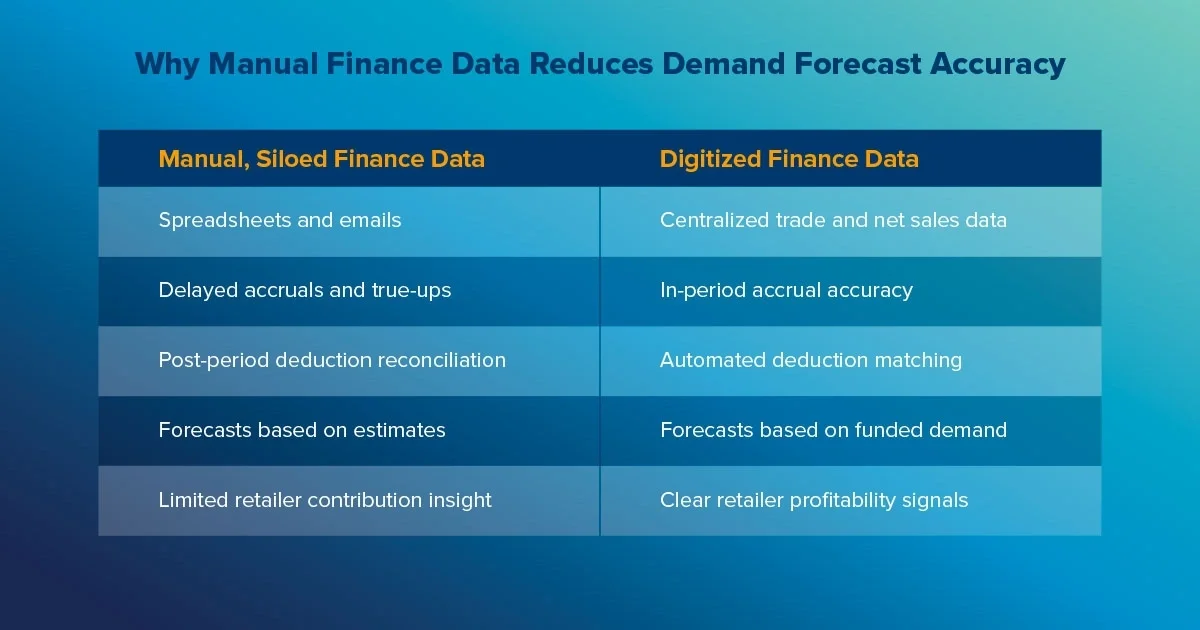
Despite ongoing investments in ERP systems, many CPG finance teams still rely on a patchwork of tools and processes to manage trade and financial data. Trade promotion details often live across spreadsheets, ERP sub-ledgers, and email or hard copy-based deal terms. At the same time, supply chain and purchasing data may be stored in entirely separate systems or tracked manually outside of the core financial ecosystem.
These silos contribute to delayed or inaccurate trade accrual entries, frequent accrual true-ups, and time-consuming deduction matching and reconciliation. Retailer performance is often evaluated as a trailing step, after actuals are finalized, rather than during planning, when corrective action is still possible.
The business impact of this fragmentation is significant. Forecasts rely on outdated or incomplete demand signals, sales volume expectations fail to align with promotion timing and funding levels, and net price realization diverges from plan.
One source suggests finance teams spend 60-70% of their time on manual data reconciliation and validation. Even if estimated on the high side, this leaves little capacity for forward-looking analysis that could positively impact forecast quality.
What Data Digitization Means for CPG Finance, Sales Planning and Demand Forecasting
Unified data architecture in finance is often misunderstood. It is not simply moving spreadsheets to shared drives or layering new reporting tools on top of existing ERP systems. Accurate digitization focuses on standardization, integration, and usability of finance-owned data.
For CPG manufacturers, this means standardizing how trade promotion plans and funding, pricing, accrual postings and adjustments, invoice-level net sales realization, COGS, supply chain costs, raw material costs, and deduction data are captured, validated, and connected across systems. The goal is to create a single, auditable source of truth that finance, sales, and demand planning teams can rely on.
Standardized finance ecosystems provide visibility into planned versus actual trade spend, net sales and margins, and retailer contribution. Gartner estimates that poor data quality costs organizations an average of $12.9 million annually, reinforcing the financial upside of improving data integrity at the source.
Three Ways Digitized Finance Data Improves Demand Forecast Accuracy
Better Demand Planning Inputs
Integrated finance data provides demand planners with cleaner, more reliable inputs. This means net price assumptions reflect actual funding levels, promotional lift assumptions are grounded in historical performance, and forecasts are based on approved trade plans rather than estimates. This alignment reduces the gap between forecasted and realized demand.
Faster Variance Detection
When trade and financial data are digitized, finance teams gain faster visibility into forecast variance. This means underperforming promotions, overfunded retailers, and early signs of margin erosion are identified in-period rather than after close.
Improved Demand Signals
Digitization also unlocks stronger retailer-level demand signals. Forecasts can incorporate retailer contribution, customer-level promotion effectiveness, historical deduction behavior, and actual retail execution against planned promotions. This level of granularity helps manufacturers differentiate between true incremental demand and volume that simply shifts timing or erodes margin.
Unified Finance Data Has a Cross-Functional Impact on Forecasting
For CFOs and finance VPs, digitized data improves forecast confidence for earnings guidance, strengthens working capital management, and reduces revenue leakage from inefficient trade spend. Better visibility into demand drivers also supports more informed capital allocation decisions.
Controllers and accounting directors benefit from automated, accurate trade accrual postings, faster period close with fewer adjustments, and audit-ready traceability from forecast to actuals. Reduced manual intervention improves both compliance and forecast reliability.
Sales directors and account managers gain more reliable volume expectations, clearer visibility into profitable versus unprofitable promotions, and stronger support for joint business planning, all of which feed back into more accurate demand forecasts.
Demand Forecast Accuracy Improves Trade Spend Effectiveness
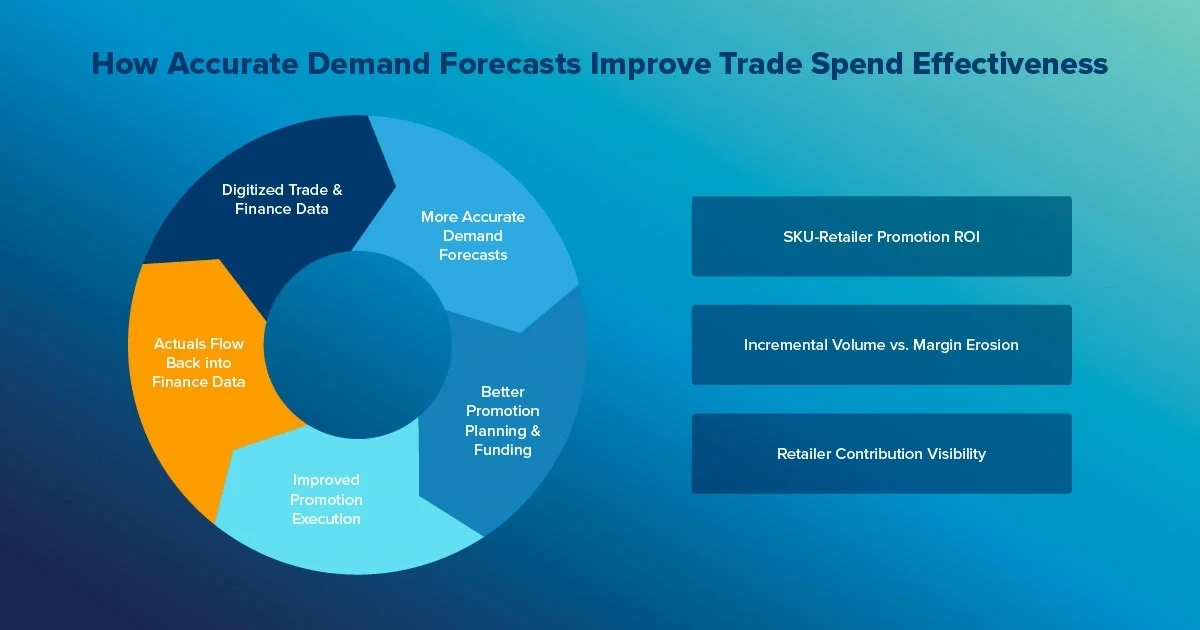
Digitized trade data directly links forecast accuracy to trade spend effectiveness. Finance teams can analyze promotion ROI at the SKU–retailer level, align forecasts to funded demand rather than optimistic volume assumptions, and create continuous learning loops from actuals back into future forecasts.
This capability enables finance to answer critical questions: Which retailers truly drive incremental demand? Which promotions shift volume without margin gain? Which retailers are most profitable to manufacturers? Up to 20% of trade spend fails to deliver no incremental volume, according to a 2023 article by NielsenIQ. This statistic highlights the importance of accurate forecasting as it relates to trade effectiveness.
Steps for Finance Teams Looking to Digitize Data for Better Forecasting
Contrary to a common assumption, finance-led data integration doesn’t require a multi-year transformation. Practical steps include standardizing trade and accrual data structures with consistent fields for funding, timing, and conditions. Connecting trade, deduction, and net sales data eliminates manual matching and offline workflows that distort forecast inputs.
Aligning the finance and demand planning calendars helps forecasts reflect the actual promotion timing and funding. Digitized insights inform forward-looking forecasts, allowing teams to shift from reactive planning to proactive decision-making.
Data Digitization is Essential for Accurate CPG Demand Forecasts
Demand forecast accuracy is not just a supply chain problem; it’s a data and finance operations challenge.
When finance and accounting teams work from a unified architecture, consumer package goods manufacturers gain stronger inputs, faster insight, and demand signals that planners can trust. It’s one of the most practical ways to improve demand forecasting accuracy without chasing complex models.
Success requires disciplined data flow across trade promotions, accruals, deductions and net sales so that forecasts reflect funded demand, real margins, and actual retailer behavior.