

Gain Forward-Looking Control of Trade Promotions Through Joint Business Planning
Building an effective joint business planning process
Most consumer products leaders agree that joint business planning (JBP) is essential, but few feel their organization executes it well. The gap isn’t intent; it’s process, data, and execution discipline. Many organizations still manage joint business planning through rearview reporting, relying on static spreadsheets and after-the-fact analysis rather than forward-looking control that enables proactive, in-cycle decisions.
McKinsey reports that approximately 60% or more of trade promotions, especially in the CPG industry, fail to break even or deliver real value due to poor planning, execution errors, misaligned goals with retailers, and lack of data visibility. Further, a 2023 CGT report found that 43% of brands still use spreadsheets for trade promotion management, hindering real-time adaptability with static and manual data. As trade investment continues to grow in importance, improving joint business planning execution is a direct pathway to improved margin and revenue.
This article, part two of two, outlines the modern joint business planning workflow and technologies that make it possible. Read part one, How CPG Manufacturers Build Stronger, More Profitable Retail Partnerships with Joint Business Planning, to learn about the JBP paradigm for building more profitable retailer partnerships for revenue growth management. Closing that gap requires a shift from reviewing what previously happened to actively managing what will happen next.
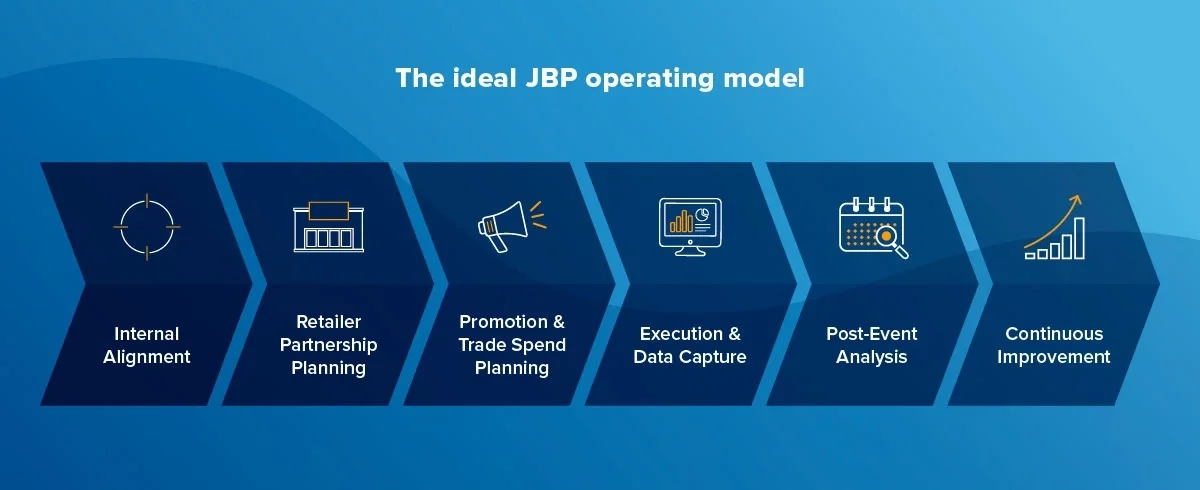
The ideal modern joint business planning process
A modern joint business planning process replaces rearview reporting with forward-looking control, connecting strategy, financial planning, execution and measurement into a continuous cycle.
A structured, repeatable process ensures that both commercial and financial objectives are met. The model below reflects best practices from leading CPG teams and top consultancies.
- Internal alignment and objective setting
Before engaging retailers, manufacturers must align internally on:
- Revenue and margin goals
- Category priorities
- Trade budget parameters
- Calendar guardrails
- Forecasting assumptions
Cross-functional collaboration between Finance, Sales, RGM, and Supply Chain ensures the team presents a unified strategy.
- Retailer partnership planning
Retailer conversations increasingly require data-backed insights and a clearly articulated point of view on category growth.
Best practice elements include:
- Shopper insights
- Category performance analysis
- Retailer-specific strategies
- Competitive benchmarks
- Innovation and assortment planning
- Promotional and trade investment planning
This stage moves from strategic alignment to financial planning. Instead of locking plans based on historical averages, teams use forward-looking scenarios to understand risk, return, and trade-offs before dollars are committed.
Teams build and evaluate:
- Consumer Focused Planning
- Promotional calendars
- Mechanics and price points
- Expected lift
- Incremental volume and margin impact
- Spend allocation scenarios
- Retailer guardrails
According to McKinsey, advanced analytics can increase promotional ROI by 10-20% and improve margin by up to 5 percentage points.
- Execution and data capture
Once plans are approved, consistency and visibility become critical.
Top-performing CPG companies:
- Codify agreements in centralized systems
- Track spend burn-down
- Monitor POS lift in near real time
- Compare executed tactics vs. agreed calendars
- Monitor supply and inventory availability
This transforms joint business planning from a static plan into a living, continuously managed process. The visibility allows teams to adjust while programs are live, rather than discovering issues weeks later through rearview reports.
- Post-event analysis and continuous improvement
Promotions create invaluable data in need of measurement.
High-performing teams use:
- Standardized post-event analyses
- Financial reconciliations versus projected ROI
- Direct comparisons of mechanics
- Customer contribution analyses
- Playbooks refined with each cycle
This discipline turns insights into next year’s improved outcomes.
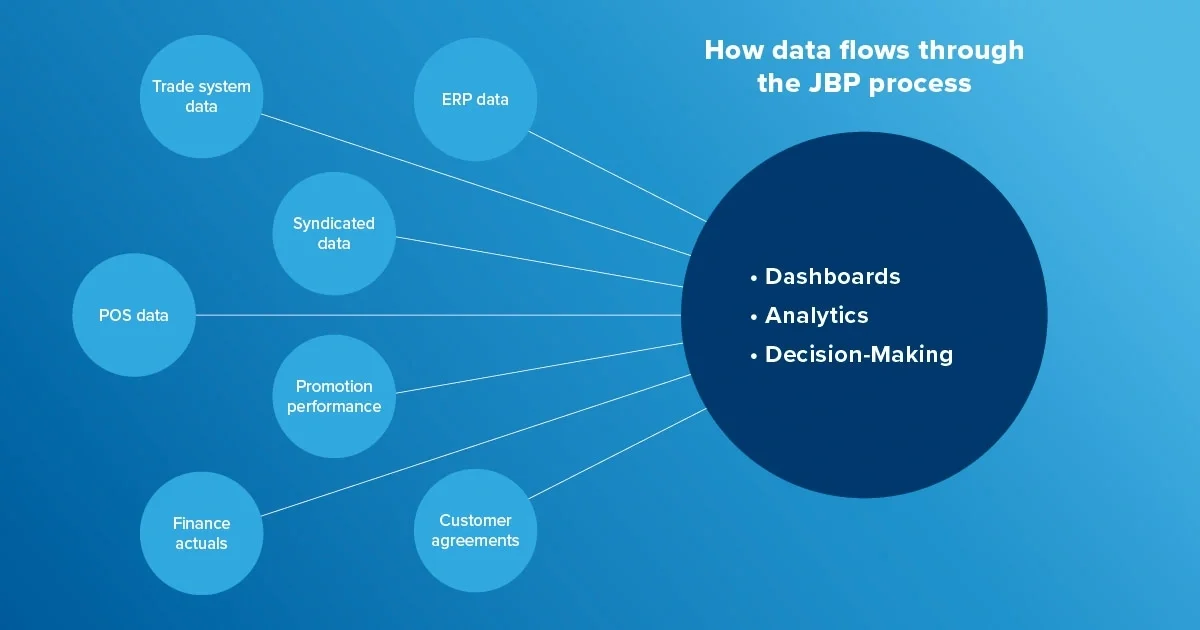
How technology accelerates joint business planning success
Technology enables the shift from rearview reporting to forward-looking control by unifying data, applying predictive analytics and embedding financial discipline into daily decision-making. The shift toward data-driven joint business planning is powered by modern revenue generation management solutions. Five capabilities are especially important:
- Unified data foundation
A single source of truth that integrates:
- Non-Traditional Consumer Data Sources
- Shipments
- POS and syndicated data
- Trade claims and settlements
- ERP financial data
- Retailer agreements
- Promotional performance
This eliminates conflicting numbers and creates trust internally and with retailers.
- Predictive analytics and AI-driven insights
Machine learning and predictive models help teams:
- Forecast lift
- Estimate ROI
- Identify inefficient spend
- Model pricing impacts
- Predict retailer contribution
- Predict consumer trends and behavior
Organizations with strong analytics outperform peers in promotional ROI.
- Scenario planning and optimization
Technology allows teams to test multiple strategies before committing funds:
- Different mechanics
- Deeper vs shallower discounts
- During-peak vs. off-peak timing
- Alternative frequency
- Retailer-specific tactics
- Consumer sentiment shifts
This ensures investment goes to the highest-return opportunities.
- Trade accrual and deduction management automation
Finance and accounting leaders benefit from:
- Automated accrual calculations
- Integrated claim validation
- Faster resolution of deductions
- Reduced financial leakage
- Improved budget accuracy
This reduces administrative burden while protecting the profit and loss statement.
- Role-based dashboards
Manufacturer teams access dynamic scorecards:
- CFO and Finance: margin, contribution, ROI
- Sales: event performance, retailer scorecards
- RGM: lift curves, guardrails, mix optimization
- Accounting: accruals, deductions, workflow status
Data shifts teams from explaining past performance to actively steering future outcomes.
The future of joint business planning: AI-enhanced collaboration
AI is reshaping how manufacturers prepare for and manage retailer conversations, including:
- Automated meeting briefs
- Predictive alerts on budget risk
- Summaries of promotion history
- Recommended tactics tailored to each retailer
- Real-time insights during negotiation cycles
Future joint business planning environments will include shared dashboards where manufacturers and retailers collaborate on the same data.
From rearview reporting to forward-looking control
A modern joint business planning process empowers CPG manufacturers to move beyond rearview reporting and manage performance proactively. With unified data, predictive analytics and disciplined financial workflows, teams gain the control needed to improve retailer performance, reduce trade waste and increase ROI on every promotion dollar.
Technology isn’t replacing the art of partnership; it’s giving teams the foresight and control required to make those partnerships more profitable.